Hector Zamora: Lattice Detour (The Roof Garden Commission)
Softcover | 11.3 x 0.3 x 18.34 cm | 64 pp | 43 illustrations
Yale University Press | 2020 | 9781588396891
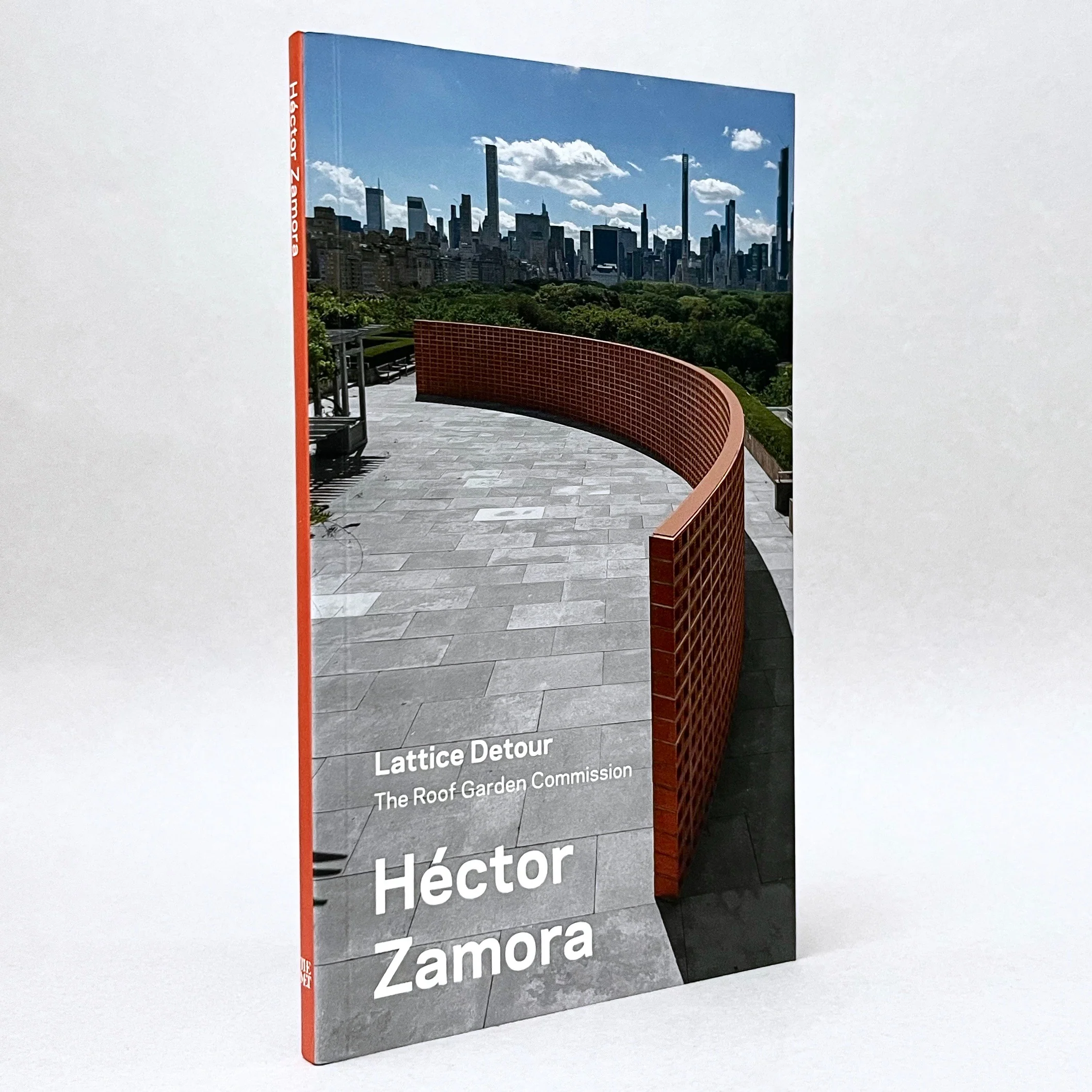
The work of Mexican artist Héctor Zamora engages with urban or built environments, both disrupting and re-articulating the viewer’s interaction with the site. Lattice Detour is fabricated from terracotta bricks produced in Mexico and transported to New York. This compact volume, the first book in English on Zamora, presents images and analysis of this artwork, setting its creation in the context of his past work. An interview with Zamora sheds further light on his formation as an artist, his process, and his inspirations.
Softcover | 11.3 x 0.3 x 18.34 cm | 64 pp | 43 illustrations
Yale University Press | 2020 | 9781588396891
The work of Mexican artist Héctor Zamora engages with urban or built environments, both disrupting and re-articulating the viewer’s interaction with the site. Lattice Detour is fabricated from terracotta bricks produced in Mexico and transported to New York. This compact volume, the first book in English on Zamora, presents images and analysis of this artwork, setting its creation in the context of his past work. An interview with Zamora sheds further light on his formation as an artist, his process, and his inspirations.
Original: $6.71
-65%$6.71
$2.35Description
Softcover | 11.3 x 0.3 x 18.34 cm | 64 pp | 43 illustrations
Yale University Press | 2020 | 9781588396891
The work of Mexican artist Héctor Zamora engages with urban or built environments, both disrupting and re-articulating the viewer’s interaction with the site. Lattice Detour is fabricated from terracotta bricks produced in Mexico and transported to New York. This compact volume, the first book in English on Zamora, presents images and analysis of this artwork, setting its creation in the context of his past work. An interview with Zamora sheds further light on his formation as an artist, his process, and his inspirations.